Orchestrate AI agents across your business
dotDash puts agentic workflows, conversational AI and search over your own data on one platform — so an idea becomes something running in production, not another integration project.
Wire AI agents to approval steps and run them in production — nothing an agent does takes effect without a human saying so.
Connects to what you already run
Bring your own databases, warehouse, messaging channels, business systems and models — or reach anything else over REST.
WhatsApp Business
Google Workspace
Microsoft 365
Slack
PostgreSQL
MySQL
SQL Server
BigQuery
Google Cloud
Vertex AI
MCP
Resend
Salesforce
HubSpot
QuickBooks
GitHub
REST / Webhook
SFTP / CSV
One platform, four moving parts
Workflows, data, dashboards and conversations. They share one identity, one data model and one audit trail, so they compose instead of needing glue.
Build workflows you can see
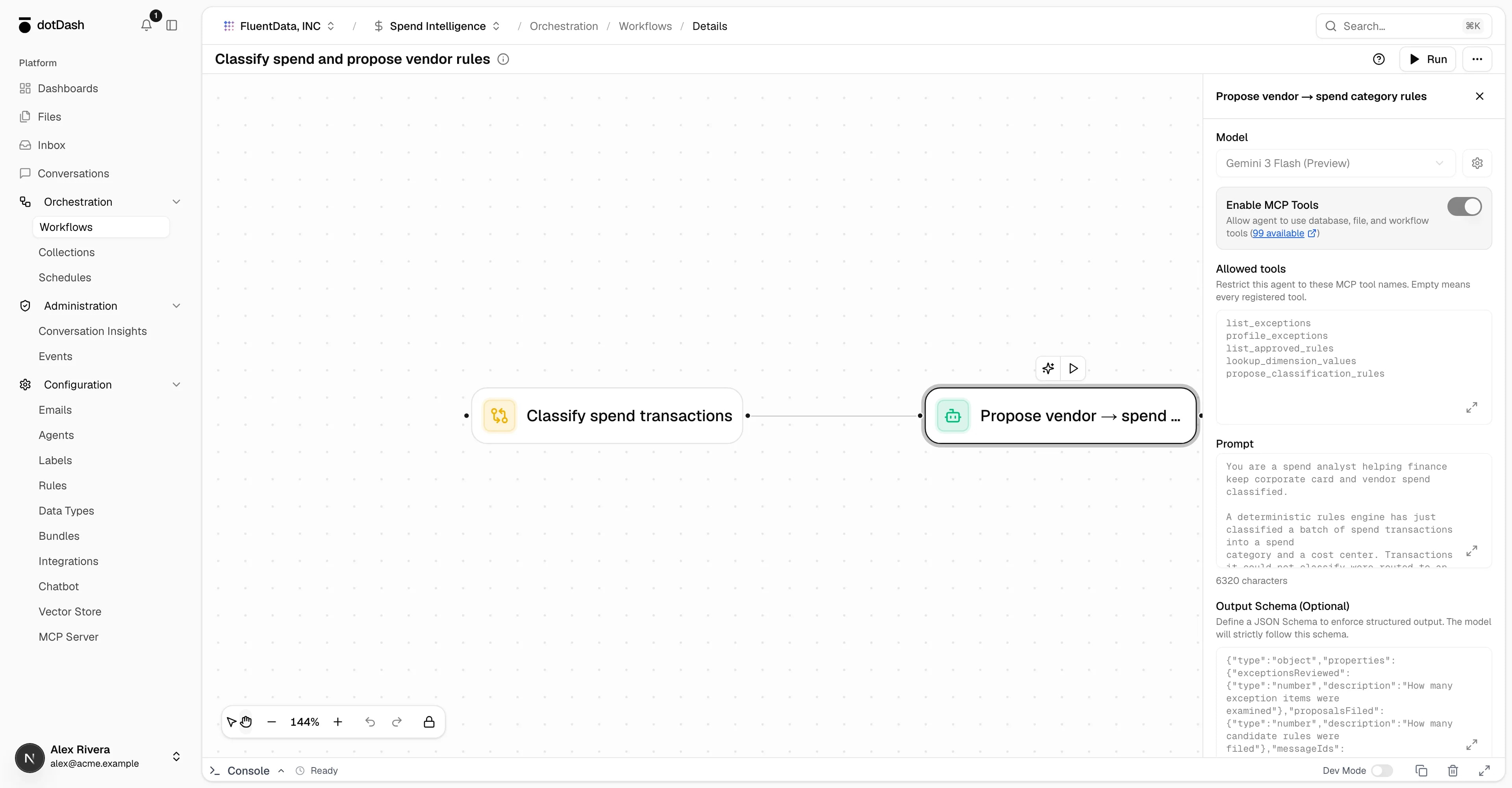
Compose agents, tools and approvals on a canvas. Agents act through MCP — query collections, search documents, call your integrations — and pause for a named person in the Inbox before anything takes effect.
Meet people where they are
One assistant across web chat, WhatsApp and Slack, grounded in your documents and collections through hybrid search — with session history and escalation to a human.
Data lands typed and batched
Files, databases and APIs land in collections with declared types. Versioned rules classify the predictable part, exceptions queue for review, and every record names the rule that decided it.
Collections
Add
Spend transactions
600 lines · batch sealed
Vendor master
43 items
Spend classification rules
v1 · 36 rules published
Exceptions
115 awaiting review
GL journal entries
importing…
Dashboards that trace back
KPIs, charts and tables over your collections. Click a member and the dashboard rescopes; break a figure down to the lines behind it — nothing is a black box.
Classified spend
$67.5K
Open exceptions
115
Spend by vendor
Isolated from every other organisation, encrypted in transit and at rest, and never used to train models — yours or anyone else's.
Granular role-based access across workspaces, with an append-only audit trail of who changed what.
TOTP enrolment and challenge, enforceable organisation-wide, alongside Google sign-in.
Separate teams, data and workflows inside one organisation, with their own members and integrations.
Processing units, searches, storage and seats are metered and shown in-product, so a bill is never a surprise.
Put any workflow on a cron schedule and let it run unattended, with execution history kept per run.
Every agent step, tool call and model response is logged and traceable, so you can explain any answer.
A complete REST API with a published OpenAPI spec. Not an upsell — API access is not a plan tier here.
Every dataset lands in a typed, batched collection — the same shape whether it came from a file, a database or an API — so rules, dashboards and agents all read the same thing.
Agent proposals and approvals arrive as messages a named person accepts, modifies or rejects — with the reason kept on the record.
A sealed batch, a published rule version or an inbound email is an event, and any workflow can subscribe to it — no polling, no glue.
Data types, rules, workflows and dashboards ship together in one versioned file, imported with a plan preview of exactly what changes.
What teams build with dotDash
Every one of these is assembled from the same parts: a workflow, an agent, your data and a channel to reach people on.
Put your first agent to work this week
Start a 14-day trial and build a workflow against your own data. Talk to us if you would rather be walked through it.


DOTDASH